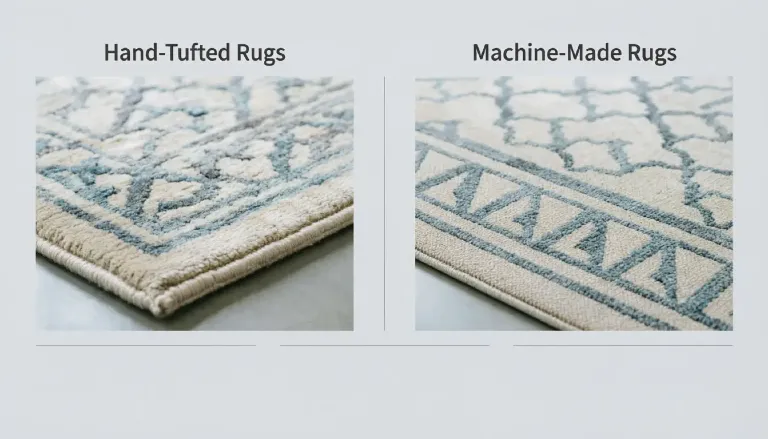
Hand-Tufted vs. Machine-Made Rugs is an important comparison when choosing the right rug for your home. While both options may look similar, their construction methods, lifespan, customization, and pricing can differ significantly.
Quick Takeaways
- Hand-tufted rugs are created by hand with the use of a tufting gun and canvas; machine-tufted rugs are made by computerized machines that control the power loom.
- Feel and density vary by yarn, pile height, and construction quality in both types — neither is automatically plusher.
- Machine-made rugs are generally the more budget-accessible option; lifespan for either type depends heavily on material and construction quality.
- Hand-tufted rugs stand out for customization because makers can create different sizes, colors, and patterns based on customer needs.
How Hand-Tufted Rugs Are Made
To make a hand-tufted rug, an artisan first stencils the design onto a canvas. The artisan then uses a handheld tufting gun to punch loops of yarn through the fabric. To punch loops of yarn through the fabric — a process Fine Rug Collection’s construction guide compares to filling in a stenciled outline by hand. After tufting, the rug needs a stable backing. The maker applies a layer of latex adhesive to the back. They then add another backing fabric, usually made of cotton or canvas.
This technique falls somewhere in between hand-knotted and machine-made techniques. While being more time-efficient and less costly than the hand-knotting method, it still includes a manual process of the rug by the individual.
Materials vary by maker — wool, cotton, and synthetic blends are all used in hand-tufted construction, and the specific fiber has more to do with feel and durability than the tufting process itself.
How Machine-Made Rugs Are Made
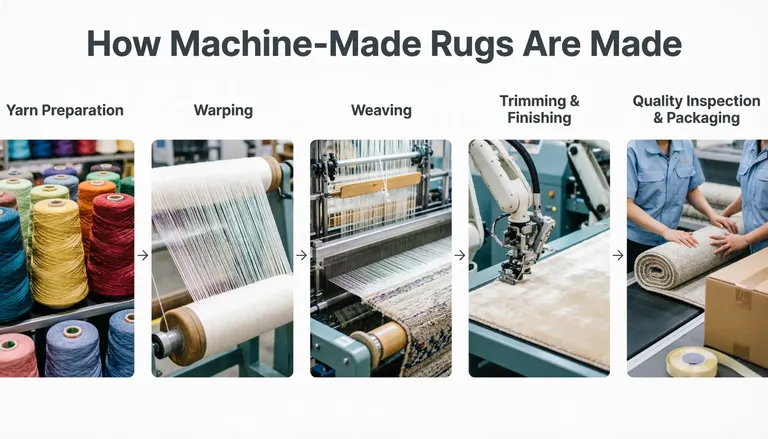
The machine-made carpet is made on an automatic loom operated by a computer program that dictates the design from a pattern file through colors and positions very quickly.
This automated process is what makes machine-made rugs fast to produce and widely available in consistent sizes and colorways.
The material used may vary from one manufacturer to another, and it may be either artificial material such as polypropylene, nylon, or polyester, or natural materials such as wool and blends of wool. In this case, the material type is more critical than the loom.
Hand-Tufted vs. Machine-Made rugs: Side-by-Side Comparison
| Factor | Hand-Tufted | Machine-Made |
| Construction | Hand-guided tufting gun through a stenciled canvas, glued backing | Computer-controlled power loom, programmed pattern |
| Common materials | Varies by maker — wool, cotton, and synthetic blends are all used | Varies by manufacturer — synthetic fibers and wool/wool-blend options both exist |
| Texture & feel | Varies by yarn, pile height, and density — can range from tight to plush | Varies by yarn, pile height, and density — can range from tight to plush |
| Customization | Sizes, colors, and patterns can typically be made to order | Some brands offer limited size/color options, but flexibility is generally narrower |
| Durability factors | Backing adhesive is a known long-term wear point; overall lifespan depends on fiber and construction quality | Depends heavily on fiber quality and construction density |
| Price | Generally a higher investment, reflecting labor and materials | Generally more accessible, especially at larger sizes |
| Often considered for | Design-forward spaces, made-to-order needs | Budget-conscious or frequently-changed spaces |
Look and Feel: What You’ll Notice Underfoot
The quality of the underfoot of a rug is determined not by how it is manufactured but by the type of yarn used. The height of pile, and the density of tufting/weaving. Some handmade rugs are manufactured using a thick and plush pile, but some handmade rugs are thinner and flatter. So do machine-made rugs.
Cheap machine-made rugs have thin and flat piles due to cost savings, while expensive machine-made rugs will be as plush as hand-tufted rugs.
For the purpose of comparing the characteristics under the foot for two specific rugs, it is better to measure their pile thickness and density.
Customization: Where Hand-Tufted Pulls Ahead
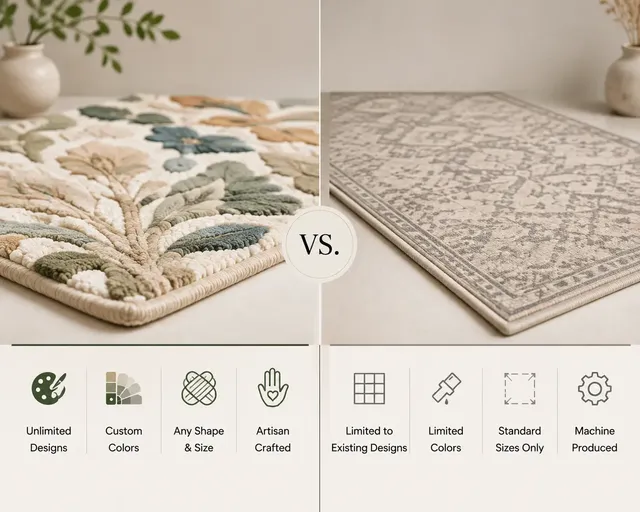
Hand-tufting starts with the hand-stencil base, hence making it very easy for you to have your own customized sizes, colors, or designs.
In case your room is oddly shaped or has certain color schemes or designs which you cannot find in any factory-made carpets, this is the right way for you.
Machine-made rugs aren’t necessarily locked to a fixed catalog — some manufacturers do offer size or colorway variations within a given design. However, since the production process of a loom is designed for high-speed manufacturing, the level of customization is limited compared to the hand-tufted process.
Can you get a machine-made rug in a custom size or color?
Sometimes, yes — a handful of machine-made rug lines offer select size or color variants. It’s just not as common or as adaptable as the customization process used in most hand-tufted carpets, where the design is designed based on your specifications and not based on an existing production line.
Durability and Lifespan
However, both of these carpets can be durable if cared for properly. Both of them wear differently, depending on use. The durability of a hand-tufted rug depends largely on the quality of the latex backing and the fiber used — regular rug care like vacuuming and rotation makes a real difference either way.
The amount of shedding that occurs in any particular rug, as well as how long it goes on, is based on the yarn quality, density of tufts, and quality of finishing of the backing. This is why shedding varies significantly from one handmade tufted rug to another.
Do hand-tufted rugs shed more than machine-made rugs?
Some new rugs may shed loose fibers during initial use, depending on factors such as yarn quality, pile density, and finishing.
This isn’t universal or automatic just because the construction uses an adhesive backing — yarn quality, tuft density, and finishing all affect how much a specific rug sheds.
Machine-made rugs shed too, particularly those that are of lower density or lower quality, and it is advisable to read the specific information about any particular rug you are purchasing.
Which type holds up better in high-traffic areas?
Neither type is automatically better for high-traffic areas — it depends more on the specific rug’s material and construction quality than on whether it’s hand-tufted or machine-made.
A durable, densely constructed rug in either category can hold up to regular foot traffic, while a lower-quality rug in either category will wear faster. USTIDE’s comparison guide offers one perspective, positioning hand-tufted rugs as a good fit for moderate-use spaces like bedrooms and home offices, and machine-made rugs as a common choice for high-traffic spots like hallways and entryways, partly because they tend to be lower-cost to replace.
That’s one retailer’s general guidance rather than a fixed rule — if heavy daily traffic is a top concern, it’s worth checking the specific rug’s fiber and density rather than relying on construction type alone.
Price and Long-Term Value
The cost of both will depend on size, materials, and brand. However, based on the price comparison among various rug vendors, it seems that hand-tufted rugs will cost slightly more than machine-made rugs.
Machine-made rugs are more easily accessible. This is one of the reasons why they are favored by renters and people who like to change the appearance of their rooms frequently. There is no “better value,” and this will depend on your expectations of the lifespan of the rug, its frequency of use, and preference between custom and inexpensive rugs.
Hand-Tufted vs. Machine-Made Rugs: Which One Suits You?
- On a budget or renting a place: Machine-made rugs will be a better choice.
- Living room with high traffic or living room with pets and kids: For these cases, consider the rug’s material, construction quality, and maintenance needs rather than choosing based only on whether it is machine-made or hand-tufted. However, a carpet, either machine-made or handmade, from thick material would surely be noticed.
- Design-forward room where texture and craftsmanship matter: A hand-tufted rug’s hand-finished character and made-to-order flexibility tend to stand out here.
- A room with an unusual size or a very specific color scheme: Hand-tufted’s made-to-order flexibility is the better fit — check our rug size guide if you’re not sure what dimensions to look for.
A rug pad can help improve grip and add cushioning underfoot, depending on the rug and flooring type for both floor types, for added comfort and grip underfoot.
Frequently Asked Questions
Is a hand-tufted rug worth the extra cost?
It depends on priorities — the cost generally reflects made-to-order flexibility and craftsmanship. For larger or frequently used rooms, it may be more appropriate to use a fine machine-made rug.
What is the average lifespan of machine-made rugs?
The lifespan of a machine-made rug varies depending on fiber type, construction quality, maintenance, and level of use.
Are hand-tufted rugs and hand-knotted rugs the same thing?
Hand-knotted rugs are created by knotting one after another without the use of any glue, while hand-tufted rugs are created by the use of punching needles in a tufting machine and then sealed by latex glue from the back side.
How do you clean a hand-tufted rug?
Vacuuming is very important; however, ensure that you do it at a low level. Lastly, it is important to clean any spills as soon as they happen.
Can hand-tufted rugs be used outdoors or in damp spaces like bathrooms?
No, Hand-tufted rugs are generally intended for indoor use, as long-term moisture may affect the latex backing over time.
The Bottom Line
There’s no universal “better” rug between hand-tufted and machine-made — it comes down to how the room is used, and what matters most to you: feel, customization, durability, or price.
If a custom size, color, artwork, or design is part of what you’re after, hand-tufted construction can offer more flexibility for made-to-order designs. Pile & Loop offers custom hand-tufted rugs built around exactly those options, if you’d like a rug shaped around your room rather than the other way around.